
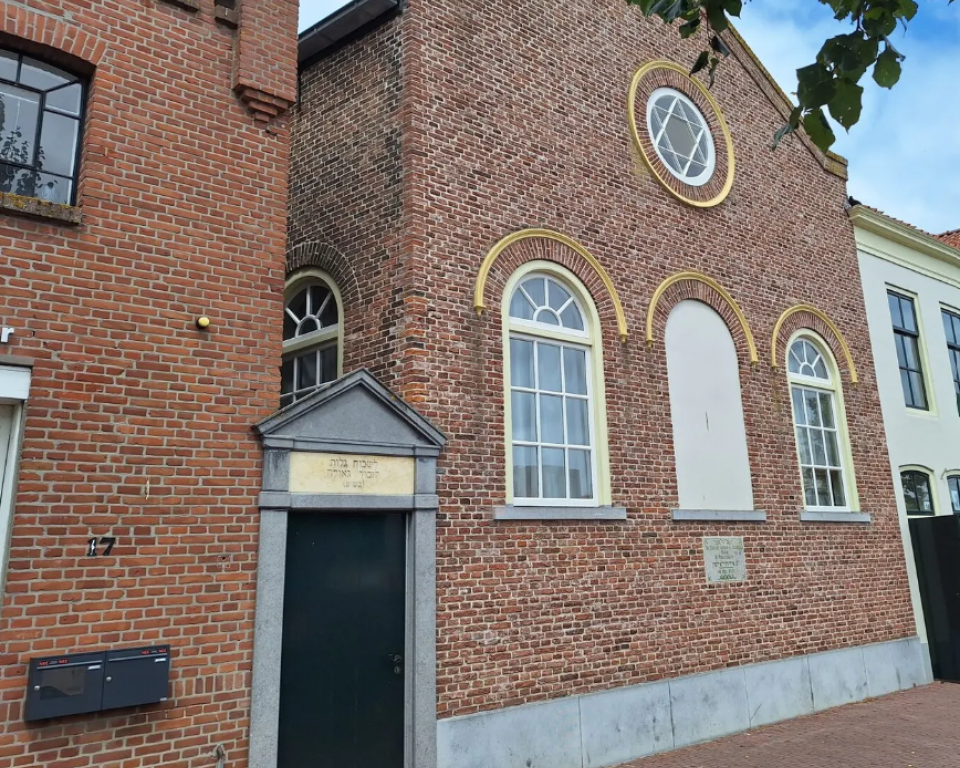
Commemoration of the Deported Jews of Voorne-Putten, the Synagogue in Brielle
Ladies and gentlemen, almost exactly 20 years ago, I took a short trip to Israel. In stark contrast to today, the Middle East was then in a period of relative calm, and I was exceptionally fascinated by this small country—and especially by its history, which has such an enormous impact on today’s world. After a day in Tel Aviv, I took the train to Jerusalem, where I spent the night in a hostel right in the heart of the Old City. What struck me most was that you could almost literally feel the weight of history there. One thing I couldn’t miss on my trip was a visit to Yad Vashem, the Holocaust memorial museum in Jerusalem. Yad Vashem is a place that leaves no one unmoved. Not only because of the horrific subject matter—the systematic and industrial-scale murder of 6 million Jews during World War II, the Holocaust—but especially because of the way visitors are drawn into the experience there.
In the museum, you trace the history of anti-Semitism. And that begins with—let me call it the classical form of anti-Semitism—Christian anti-Semitism, in which Jews are blamed for the death of Christ. One of the consequences of the hatred stemming from this form of anti-Semitism was that Jews were excluded from many professional groups and guilds. Because they were thus forced to turn to banking, among other fields, economic anti-Semitism arose, with the persistent stereotype of the “rich Jew.” An image that still persists today. In the second half of the 19th century, following the emergence of Darwin’s theory of evolution, racial anti-Semitism—the theory that Jews were an inferior race—began to take hold, ultimately serving as the breeding ground for Nazi ideology and the horrific catalyst for the Holocaust. As a visitor to Yad Vashem, you are drawn, step by step, into this centuries-long, horrific downward spiral and come to feel something of the vulnerability and fear that Jews have always felt—and still feel today.
Former U.S. Secretary of State Madeleine Albright understood this better than anyone. In a speech at the United States Holocaust Museum, she said, “I think that the problem of antisemitism has been, unfortunately, with us for centuries.” She therefore believed that antisemitism must be actively combated. For her, this had a particularly special significance: Albright, born in 1937 in what was then Czechoslovakia, had been raised as a Catholic by her parents. It was not until she was 59 years old that she discovered her parents were Jewish and that no fewer than 26 of her relatives, including three grandparents, had been murdered in the Holocaust. It suddenly made the suffering of the 6 million murdered Jews very personal to her. And that is also the message behind Yad Vashem. The Holocaust is not about the genocide of 6 million Jews, but about 6 million individual Jews who were murdered. About people with their own faces and their own life stories. About the Philipse family. About Liesje Gazan. And about Roosje Frenkel.
How wonderful and how important it is, then, that we gather here together at the synagogue at the end of October to bring their stories back to life. For, to conclude with the words of Madeleine Albright: “We must never allow ourselves to forget.”