
Closing speech 80 years of freedom
On Saturday, December 6, Mayor Scheepers concluded 80 years of freedom with the speech below.
Ladies and gentlemen,
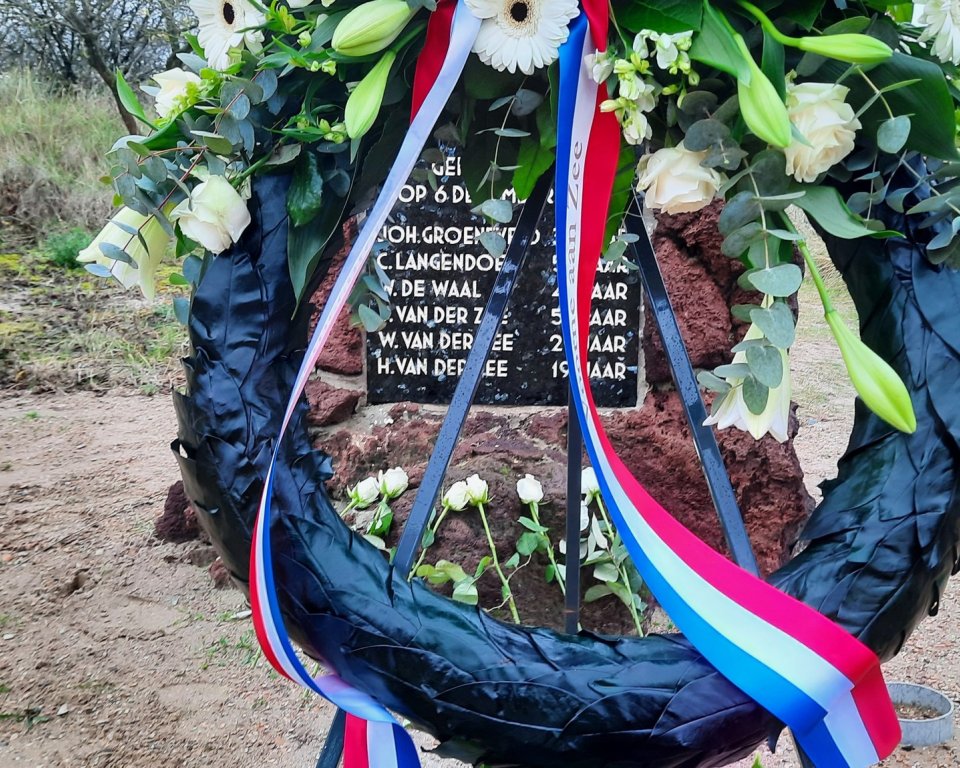
Welcome to the Badhotel in Rockanje. We have just commemorated six men who were executed by the German occupiers 81 years ago at the monument near the Second Battle. Last year, this commemoration, together with the commemoration of Leendert van der Meer and the commemoration in Zwartewaal on December 4, marked the start of the commemoration and celebration of 80 years of liberation and freedom. And today, we conclude this special year of commemoration here.
A year in which we commemorated the war, wartime, and war victims, and in which we celebrated our liberation and freedom with great enthusiasm. With an 80-kilometer tour of the island in old army vehicles. With a special edition of Veterans' Day and a fantastic edition of the Brielle Liberation Festival.
And then there are all those other initiatives, such as the other liberation festivals and the opening of the Biberbunker. This special commemorative year, which becomes clear once again when we visit the monument at the Second Battle, makes one thing very clear to me: the grand narrative of freedom and liberation is beautiful, but it only really hits home when it becomes personal. And when it's about real, ordinary people. Like Anton van der Zee. Or Cornelis Langendoen. Or the Hoogvliet brothers, who gave shelter to a British pilot. Because the grand stories about freedom are important and impressive, but it is precisely those personal stories that not only make the war very tangible, but also show what life without freedom is like. I would like to take you through three of these stories.
First, the story of Philip Pocailo. Pocailo was a Canadian pilot who, in May 1944, was shot down in his Lancaster bomber after a bombing raid on Duisburg in preparation for D-Day and landed in a field in Nieuwenhoorn. Through the local resistance, he ended up with the Braal couple in Oostvoorne. Frans and Mies Braal offered shelter to no fewer than 26 people during the winter of 1944-1945. One day, Mies Braal was standing in the kitchen with Pocailo when a German officer suddenly walked in, looking for a place to set up a field hospital. He asked Mies Braal two things: whether she knew of a suitable place for the hospital and who her kitchen companion was. Mies Braal, with great presence of mind, replied wittily: a cousin. The officer went to investigate and returned shortly afterwards without success. He had not found a suitable place. He thanked Mrs. Braal and wished her good luck with her "cousin." The officer was well aware of what was going on here, but chose not to betray Pocailo and the Braal couple. Pocailo survived the war and died in Ottawa in 2016 at the age of 95.
The second story is about a very ordinary boy from Oostvoorne, Benjamin Wessels. Ben was a teenager and played the clarinet. And Ben was Jewish. In 1942, the Wessels family was forced to leave Oostvoorne, first to Amsterdam, later to Westerbork. From that moment on, Ben wrote letters to his friend Johan in Oostvoorne. Those letters express a zest for life, despair, and homesickness for Oostvoorne. He would love to have his clarinet back so he could play again. He asks Johan to send him postcards of the dunes and the Stationsweg. He writes about his brother Nathan, whom he misses. Nathan is already dead by then. Benjamin himself dies in Bergen-Belsen, shortly before liberation.
The last story is about a girl. A girl who misses her father. She still has regular contact with him and enjoys talking to him. As a young child, she doesn't give much thought to the fact that her father is taking great risks. Her father is fighting on the front lines, but as a child, you don't normally think about mortality. Her father misses his little girl terribly. And I can imagine that intensely: I miss my children even when I haven't seen them for a day. But her father realizes that every conversation with her could be the last. He is Ukrainian and is fighting on the front lines.
These three poignant, personal stories not only touch me deeply, but also make it clear to me that history is trying to teach us a number of lessons. The first makes it clear that war is not just black and white. Of course, there are stories where good and evil are very clear-cut, but there are also shades of gray. Like the German officer who chose not to betray a pilot in hiding and his helpers. Let's keep an eye out for these shades of gray.
The second lesson is that you always have a choice. A choice to do the right thing, even when it goes against the grain. And to fight for freedom and the freedom of our fellow human beings. And that choice is incredibly difficult and risky. The Braal couple, Anton van der Zee, Willem de Waal: they all made a choice. Out of love for a son or brother. Or out of love for our freedom. Or both. And at great risk.
The third lesson is the saddest. It is the lesson that, 80 years later, we have not made much progress. Worldwide, the number of free democracies is declining and more and more autocratic regimes are emerging. At the conference organized two weeks ago by the Association of South Holland Municipalities and the Province of South Holland, the former NCTV, the National Coordinator for Security and Counterterrorism, Pieter-Jaap Aalbersberg, put it aptly: we must realize that for many countries, war is now a winning concept. I realize that this is a somewhat gloomy story. But I am an optimistic person. So I will end with a message of hope. Because even though more and more countries are moving from democracy towards autocracy, there are also countries that are taking the opposite course.
Moldova is a very good example of this. This country, located far in Eastern Europe and which Russia would like to see within its own sphere of influence, has nevertheless opted for democracy, freedom, and Europe, despite misinformation and enormous pressure from Russia. So here too, the same applies: you always have a choice, no matter how difficult that choice may be. And so let us now make that choice out of love for our freedom. For are we not the first fruits of freedom? Noblesse oblige. Noblesse oblige. History has placed a very special responsibility on our shoulders when it comes to our freedom. And so we will continue to cherish, emphasize, and maintain our freedom. We will continue to give guest lectures at schools, but we will also look for other ways to strengthen our freedom. Such as organizing a freedom dinner!
Ladies and gentlemen, I will conclude. We celebrated and commemorated in style last year. It is therefore important that we continue to remember this year. And that is why we have created a booklet. It contains nine reflections from people in our community who have contributed to 80 years of freedom. A booklet with nine beautiful and special stories about freedom in Voorne aan zee. I would like to present the booklet to the youngest contributor, Amy.
Thank you.